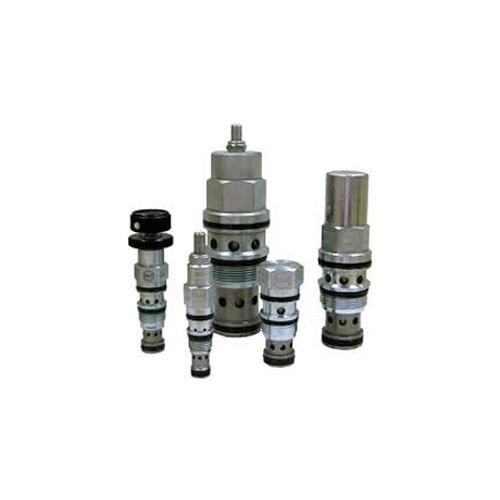
Sun Hydraulics Directional Check Valves
Sun Hydraulics directional check valves are screw-in cartridge valves that control the direction of flow within a hydraulic circuit. The range covers four main functional families: free-flow check valves, mechanically operated back-to-back check valves, pilot-to-open check valves and pilot-to-close check valves, each available across multiple cavity sizes from Series Z up to Series 4.
Free-flow check valves are simple on/off components that allow flow in one direction and block it in the other, with no external control needed. Nose-to-side and side-to-nose orientations are both available, along with variants that add a customer-specified bypass orifice to allow a controlled amount of reverse flow, a third port blocked off for use as a straightforward two-port check in a three-port cavity, flush-mount and insert-style bodies, and a position switch option that confirms whether the valve is seated or in transition.
Mechanically operated back-to-back check valves, sometimes called phaser checks, are a pair of poppets fitted back-to-back and installed into the piston or rod of a cylinder. When the cylinder reaches the end of its stroke, the poppet is mechanically shoved off its seat, opening flow through the piston and allowing two cylinders to synchronise. Installation requires Sun’s dedicated tool (part number 998-101).
Pilot-to-open check valves allow free flow from port 2 to port 1 and block reverse flow until pilot pressure at port 3 opens the valve; the pilot pressure needed is directly proportional to load pressure at port 1. Standard-pilot and sealed-pilot versions are available, along with a vented option that is insensitive to pressure at the outlet port because the spring chamber is referenced separately, either atmospherically or via an external vent port. A specialist 5:1 pilot ratio version is available alongside the standard 3:1 ratio, and manual load release options (including a tamper-resistant version) let an operator open the valve by hand.
Pilot-to-close check valves work the opposite way: they allow flow from port 1 to port 2 and block reverse flow, with pilot pressure opposing port 1 pressure at a fixed ratio. Most models use a 1.8:1 ratio and are intended for regeneration circuits, but specialist high-ratio versions are also available: a 20:1 ratio valve and a 120:1 ratio valve, the latter (COFO) purpose-built to discharge a hydraulic accumulator automatically when the pump is switched off.
Across the range, maximum operating pressure is 5000 psi (345 bar), with a small number of common-cavity models rated to 3000 psi (207 bar). Standard seals are Buna-N, with EPDM, Viton and, on many models, polyurethane also available. Corrosion-resistant stainless steel bodies (suffix /AP) and mild steel, zinc-nickel-plated bodies (suffix /LH) are offered on selected models.
Valve Families and Function
| Function | Behaviour | Notable variants |
|---|---|---|
| Free-flow check valve | Free flow one way, blocked the other, no external control | Bypass orifice, port 3 blocked, flush mount, insert style, position switch, common cavity |
| Mechanically operated back-to-back check | Pair of poppets, mechanically opened at end of cylinder stroke, for cylinder synchronisation | Single or dual mechanical actuation, external pilot port option |
| Pilot-to-open check valve | Blocks reverse flow until opened by pilot pressure at port 3 (3:1 ratio standard, 5:1 available) | Standard or sealed pilot, vented (atmospheric or external vent), manual load release |
| Pilot-to-close check valve | Allows forward flow, closes when pilot pressure opposes port 1 pressure (1.8:1 ratio standard) | Bypass orifice, 20:1 and 120:1 high-ratio versions, accumulator discharge valve |
Sun Hydraulics Directional Check Valves: Key Specifications
| Series | Cartridge Thread | Valve Hex Size | Installation Torque | Typical Port Options |
|---|---|---|---|---|
| Z | 3/8-24 UNF | 5 mm | 11–14 Nm | 3-port |
| P | M16 | 22.2 mm | 27–33 Nm | 2-port, 2-port (deep), 3-port |
| 0 | M16 | 19.1 / 25.4 mm | 27–33 Nm | 2-port, 2-port (deep), 3-port, 4-port |
| 0C | 3/4-16 UNF | 22.2 mm | 19–22 lbf ft | 2-port, 3-port, 4-port (common cavities) |
| 1 | M20 | 22.2 mm | 41–47 Nm | 2-port, 3-port, 4-port, 6-port |
| 1C | 7/8-14 UNF | 1 1/16 in / 25.4 mm | 31–35 Nm | 2-port, 3-port, 4-port, 5-port (common cavities) |
| 2 | 1″-14 UNS | 28.6 mm | 61–68 Nm | 2-port, 3-port, 4-port, 6-port |
| 3 | M36 | 31.8 mm | 203–217 Nm | 2-port, 3-port, 4-port, 6-port |
| 4 | M48 | 41.3 mm | 474–508 Nm | 2-port, 3-port, 4-port, 6-port |
- Maximum operating pressure: 5000 psi (345 bar) across most of the range, 3000 psi (207 bar) on selected common-cavity models
- Maximum valve leakage: typically 1 drop/min at 110 SUS (24 cSt); 5 drops/min on the accumulator discharge valve and common-cavity models
- Cracking pressure options: typically 4–150 psi (0.3–10.5 bar) depending on model, with some models offering options as low as 1 psi or as high as 200 psi
- Bypass orifice range (where fitted): customer-specified, typically .016–.062 in on smaller cavities up to .016–.354 in on the largest
- Pilot ratios: 3:1 standard and 5:1 (pilot-to-open); 1.8:1 standard, 20:1 and 120:1 (pilot-to-close)
Features and Benefits
- Free-flow, pilot-to-open and pilot-to-close functions are all available in the same cavity series, so a circuit can be built around a consistent cavity footprint
- Bypass orifice options allow a controlled, customer-specified rate of reverse flow rather than a hard block
- Vented pilot-to-open valves remain unaffected by outlet pressure, giving more predictable pilot control
- Manual load release, including a tamper-resistant version, allows safe manual lowering of a suspended load
- Position switch variants give electrical confirmation of valve position for machine safety or diagnostics
- Specialist high pilot-ratio valves (20:1, 120:1) and the dedicated accumulator discharge valve address specific circuit requirements without custom engineering
- Corrosion-resistant stainless steel construction available for harsh environments
Downloads
The following download is available from Sun Hydraulics:
Contact Us for further technical details and configuration options.